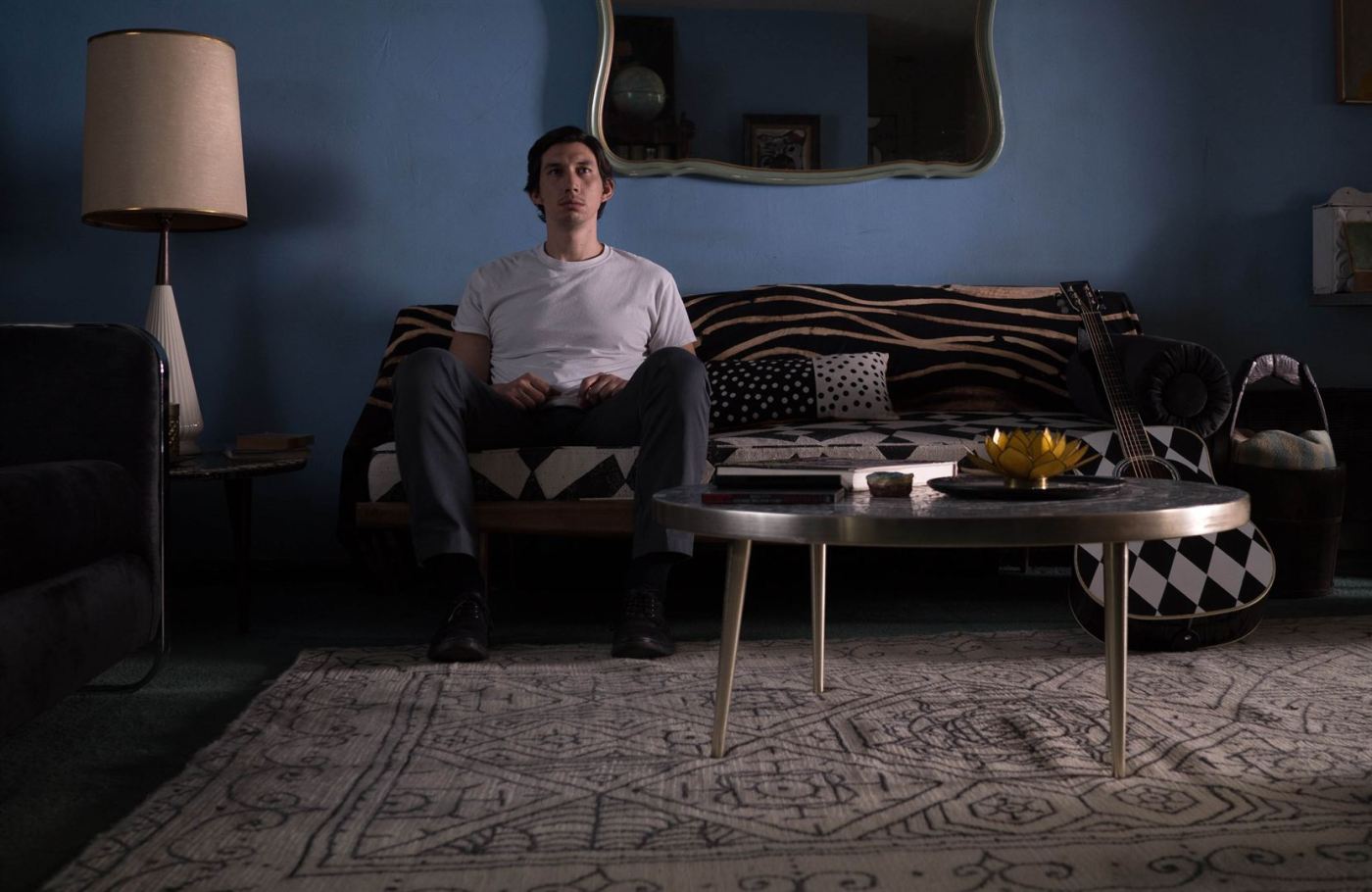
Inspired by William Carlos Williams, Jim Jarmusch builds his latest film Paterson like a poem, and the result is one of the most simple and pleasant films I’ve seen in a long time. By avoiding backstory and plot complexity, Jarmusch allows us to simply dwell in Paterson’s world—a world that manages to be simultaneously realistic and beautiful, mundane and profound.
Paterson follows a week in the life of a bus driver and amateur poet in the town which shares his name, each day acting as a stanza made up of rhyming events, settings, and camera angles. We start the day with an overhead shot of Paterson (Adam Driver) and Laura (Golshifteh Farahani) in bed. Paterson wakes up, looks at his watch, puts it on, and gets up. He then walks to work, writes for a while, listens to the complaints of his coworker, drives the bus, and eavesdrops on a conversation between two passengers (always brilliantly written). We get parallel shots of the bus’s windshield and of its interior reflected in the rear-view mirror during these scenes. At lunchtime, Paterson writes beside the waterfalls central to William Carlos Williams’ epic poem (also called Paterson). Then we see him return home from work, straighten the mailbox which has fallen over, look bemused at Laura’s latest creative endeavors, take her bulldog Marvin for a walk, and stop for a drink at his favorite bar. This pattern is repeated five times with little variation, so that when the weekend finally comes to disrupt it it is both a jolt and a relief. Like any good poet, Jarmusch knows when to break the rules, and this sudden break in Paterson‘s structure heightens the importance of events that could otherwise seem unexceptional.
Like a poem, Paterson also makes use of repeated images, particularly doubles. On Monday, Laura tells Paterson of a dream in which they had twins, and for the rest of the film, Paterson meets or sees twins almost daily. We also see this doubling between Paterson the man and Paterson the town, Paterson and William Carlos Williams as poets, and Laura and her movie star lookalike. While this imagery is thankfully never over-explained, I think that one purpose may be to highlight the fact that Paterson is not special. The film doesn’t point this out in a defeatist way; rather, it celebrates the fact that there are poets and artists everywhere. A man rapping at the laundromat, a tourist on a park bench, a child waiting at the bus stop, and the bus driver himself are all poets, and that is beautiful, but it doesn’t set them apart from the rest of the world. Like William Carlos Williams, who was a small-town doctor first and a poet second, Paterson has no lofty idea of himself as a poet. In contrast to Doc’s (Barry Shabaka Henley) wall of fame at the bar or Laura’s ambitions to be a famous country singer/cupcake chef, Paterson is content with enjoying the poetry of everyday life and keeping his poems hidden in a secret notebook.
It is because of this that I’m alright with the fact that Paterson’s poetry isn’t particularly good, although I could do away with the dramatic music (the only non-diegetic music in the film) that plays during his poetry-writing sequences. If Paterson had set up its main character as a genius trapped in a blue collar job in a dead-end town, then I would have found it annoying that a poem written by a 10-year-old girl was by far the best original poem in the film. But this is not A Portrait of the Artist as a Young Man. There is no pretension in this refreshingly unromantic portrait of an artist. And because of this, I can enjoy the beauty of Paterson whole-heartedly.
 Weird Pretty Hand
February 27, 2017 at 8:17 pm
This will be next on my list. I just saw I Don’t Feel at Home in the World Anymore. I’m curious to know your thoughts on that one.
LikeLiked by 2 people
March 15, 2017 at 4:13 am
I just watched that one. I liked living the justice of an ordinary person taking matters into her own hands, and the quirky characters.
LikeLike